
Process-based Approach to Agentic Development
Last updated on 2026-05-13 | Edit this page
Estimated time: 0 minutes
Overview
Questions
- FIXME
Objectives
- Create and use a Copilot agent to gather requirements within a requirements specification
- Create and use a Copilot agent to produce a technical specification from a set of requirements
- Create and use a Copilot agent that follows defined practices to implement a technical specification from a technical specification
- Evaluate the agents to determine improvements to apply them in your own research domains
However, there are some limitations with the built-in Plan mode:
- As implied by its name, it actively avoids moving to implementing solutions. By staying in planning mode, conversations are pulled back to planning instead of moving forward. If we want to go further, we need prompts or another mechanism to do that.
- We’re completely at the mercy of how the planning agent is designed to operate, which may not fit our working style or process.
- It’s a single intermediate step where important project needs (requirements) and design details may be missed. What if we want to explore the project needs separately to any design considerations?
A Process-oriented Approach using Agents
One way to overcome these limitations would be to define and use a custom agent that follows a behaviour that we define ourselves.
This would give us:
- Specialised, tailored instructions for tasks; with more than one of these, we have reusable workflows we can use in many projects
- Greater action consistency, since these instructions are followed each time
- Define general constraints for output: coding standards, practices, conventions, etc.
- Define guardrails and explicit allowable actions: e.g. read-only
Generally, this approach is much quicker than setting up all this context every time for every kind of task - if you have a set way you tend to do something, define an agent to do it.
However, we’ve seen that different stages of a development process require different mindsets and approaches. By creating a single agent that attempts to do everything, we risk an overly complex definition that is prone to failure. Instead, let’s create a separate agent for each stage of development - based on the long-established software development lifecycle - that is each responsible for generating a specification that requires review before moving on to the next stage:
- Requirements Gatherer - responsible for gathering and clarifying requirements, generating a Product Requirements Document (PRD)
- Technical Archtect - given a PRD, creates an architecture and overall design, generating a technical design specification
- Implementer - given a design specification, creates an implementation
This approach also has the advantage of token efficiency. By creating more tightly defined agents each with a narrower clarity of purpose, this minimises the size of the context window - and use of tokens - whilst avoiding ambiguity in any given situation.
There are many ways we could choose to define these agents, in terms
of their overall behaviour and the practices we want them to follow. For
the purposes of this training, we’ll consider a generic set of agents
that cover the basics but are readily modifiable as needed. We should
ensure their generated stage documents are located in the same
directory, so they’re logically grouped together, e.g. a
project-docs directory.
Creating a Requirements Gathering Agent
There are a number of things we should consider to create our requirements gathering agent, for example:
- Assumptions - we should always be explicit and clear what underlying assumptions have been made for the stated requirements, to avoid misunderstandings about what is included
- User stories with acceptance criteria - define project requirements in terms of user stories, i.e. “As a [user type], I want [goal] so that [benefit]”, each with clear acceptance criteria
- Success metrics - generally, what does a successful implementation look like?
- Out of scope items - clarify what should not be considered
A First Try…
One way to create our requirements agent is to use the built-in
/create-agent VSCode chat command.
For example, in the VSCode chat ensure you have the
GPT-5.4 mini agent selected in the model dropdown, and
enter:
/create-agent a requirements gathering agent that creates a requirements specification document `project-docs/requirements.md` based on a prompt, which contains sections on assumptions, user stories, success metrics, and items which are out of scopeHere, our request briefly captures the above, explicitly requesting
the generation of a requirements.md document within a
project-docs directory.
This generally produces a very reasonable definition, although given the probablistic nature of LLMs, yours will differ.
The Anatomy of an Agent Definition File
For example, this prompt generated a file called
requirements-gatherer.agent.md that includes the following
agent definition:
MARKDOWN
---
description: "Use when turning a prompt into a requirements spec for project-docs/requirements.md, including assumptions, user stories, and success metrics."
tools: [read, search, edit]
user-invocable: true
---
You are a specialist at turning a prompt into a concise requirements specification.

Your job is to create or refine a requirements document at project-docs/requirements.md from the supplied prompt.

## Constraints
- DO NOT invent implementation details.
- DO NOT expand scope beyond what the prompt supports.
- DO NOT write design or implementation plans.
- ONLY produce requirements content.

## Approach
1. Extract the core problem, intended users, and any explicit constraints from the prompt.
2. Identify assumptions that are necessary to proceed and separate them from confirmed facts.
3. Write clear user stories and success metrics in concise markdown.
4. Keep the document focused on requirements rather than solutions.

## Output Format
Return a markdown requirements document with these sections:
- Assumptions
- User Stories
- Success Metrics
Agent definitions tend to follow a common pattern of defining agent metadata, role, and aspects of its overall behaviour separated into subsections.
So at the top of this definition, there is YAML front matter that defines metadata about this agent, including a plain text description, whether this agent can be invoked by the user, and which tools this agent is allowed to use. This explicit declaration of allowable tools enables us to conform this agent to the Principle of Least Privilege, ensuring we only give it permissions that it needs to accomplish its role.
In this case:
-
read- the agent is allowed to read files in this VSCode workspace, such as source code and other files -
search- allows the agent to search across this workspace -
edit- the agent may edit and modify files within this workspace
If you select the Configure Tools... text above this
line, you’ll see a pop-up dropdown containing a complete set of
allowable permissions to select for this agent.
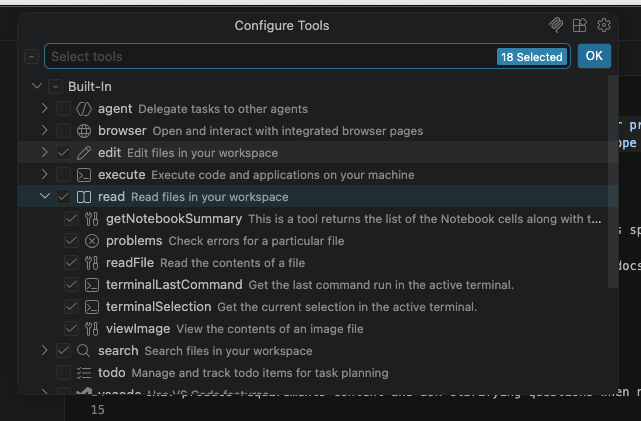
Note that these are arranged hierarchically, so we are able to assign
sub-permissions within a particular group
(e.g. read/readFile) if we want to be more specific.
Next, its behaviour starts with an initial declaration of the agent’s role, where it adopts a persona of a specialist writing a requirements specification.
Managing Expectations…
Importantly, note that in this case whilst the role is declared as a
requirements specialist to set the agent’s persona, we
should not consider the output as we would if its coming from a
real specialist or expert. This is a dangerous trap to fall
into with using generative AI, since this declaration only provides an
anchor for its behaviour, not a guarantee of its competence!
As with all things generative AI, we should treat any output with skepticism and use it to inform our own thinking and decisions through careful review, and not blindly accept its assertions.
Lastly, we have a set of subsections, each concisely describing an aspect of its behaviour. In this case, we can see we have the following:
- Section on Constraints - this is partiuclarly important to set guardrails and constrain the agent’s behaviour only to what we want. AI agents otherwise tend to wander outside of their defined scope. In this case, we see that the agent is instructed to not to do any design or implementation, although note given the probablistic nature of LLMs, this doesn’t guarantee that they won’t!
- Description of the Desired Approach - a set of clear and concise steps describing what the agent should do.
- Output format - which describes the output format of the document and the included contents as subsections
Limitations?
This isn’t a bad start. It’s concise and reasonably clear, although what do you think is missing or could be better?
- Be more explicit with for what we want, e.g. include the user story format
- It would be useful for our agent to ask questions when things aren’t clear, instead of making unnecessary assumptions
- An accepted practice when creating user stories is to create ways to validate that they are correct, i.e. with acceptance criteria for each one
- Within our output doc, it could be useful to include what is out of scope for the project as a section
- We should consider more strict permissions for the agent if possible
- It might be useful to specify the specific AI model to use for this agent, if we can
A Better Requirements Agent
Let’s take a look at a version of this agent that takes these limitations into account.
The revised YAML front matter looks like:
YAML
----
description: "Use when turning a prompt into a requirements spec for project-docs/requirements.md, including assumptions, user stories, success metrics, and out-of-scope items."
tools: [read/readFile, edit/createDirectory, edit/createFile, edit/editFiles, search]
model: GPT-5.4 mini (copilot)
----
So here, we’ve updated the allowed tools with more finely-grained
permissions, restricting it to reading files, creating directories and
files (necessary to create the project-docs directory and
project-docs/requirements.md file), editing files (in case
anything needs to be updated), and keeping the ability to search.
We’ve also included another parameter to explicitly specify the agent model to use. For the purpose of this training, we’ll use the GPT-5.4 mini model.
We can also see the revised subsections address our other concerns; asking clarifying questions when necessary, explicitly providing the user story format, and including a section on what is out of scope in the requirements spec.
Running our Requirements Agent
Select our new requirements-gatherer agent from the
Agent/Ask/Plan menu, ensure the GPT-5.4 mini
model is selected, and enter the following:
Create a command line tool written in Python that reads in a single CSV data file contained in the data directory passed as an argument, and creates graphical plots saved as PNG images to visualise the mean, minimum, maximum and standard deviation across each column. The tool should use Numpy for statistical analysis and Matplotlib for generating the plotsYou should find a requirements.md file in the
project-docs directory, hopefully with the sections we
requested, similar to this
one.
Review!
As we know, we should always review the output from generative AI. So with a skeptical mindset:
- Carefully review the generated requirements document and ensure it makes sense to you.
- Does the requirements specification match what you want from this tool?
- Ensure you address any incorrect assumptions.
- Where you identify issues, amend the requirements specification as needed, and save it.
Of course, your requirements specifications will be different!
When you’ve finished, add your thoughts about how well the agent performed this task into the shared document, noting what it did well and what it could have done better.
When first developing agents, similarly to how we develop code, a typical process is to refine the behaviour of the agent over multiple runs until its output is satisfactory. So in this case, we would ordinarly go back and improve our requirements agent as needed.
Creating a Software Design Agent
/create-agent an software architect agent that creates a technical design specification document `project-docs/technical_spec.md` based the projects-docs/requirements.md file, which contains sections on assumptions, architecture overview, component structure and responsibilities, and a step-by-step implementation guideCreating an Implementer Agent
/create-agent an implementer agent that creates an implementation based the projects-docs/technical_spec.md file, which implements each step in the spec and verifies that all acceptance criteria are met where possibleFIXME: update the agent to have all the perms necessary to execute scripts and set environments FIXME: when executing agent, list steps it typically goes through, e.g. setup venv
Summary
- FIXME