
3.3 Sprint Retrospective
Last updated on 2026-02-19 | Edit this page
Estimated time: 30 minutes
Overview
Questions
- What is the primary purpose of a Sprint Retrospective?
- Who participates in a Sprint Retrospective?
- How can reflecting on estimates of effort improve future sprint planning?
- Why is it important to identify assumptions that affected the Sprint
Objectives
- Define the key elements of a Sprint retrospective
- Listen and respect other team members’ opinions
- Reflect on how the prioritisation strategy worked
- Reflect on what went well and what could be improved
- Collate actual effort expended across team, compare against estimated
- Calculate and visualise an effort burndown chart based on expended effort
Introduction to Sprint Retrospectives
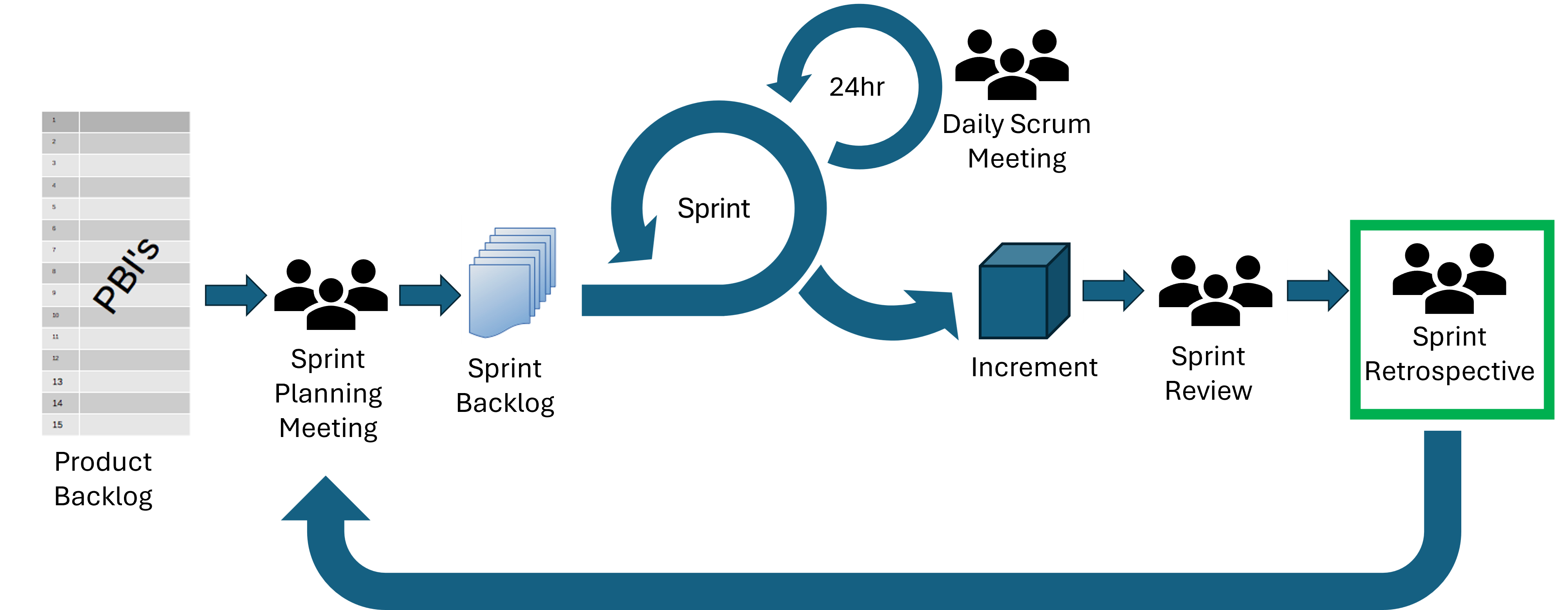
The Sprint Retrospective is a reflective session held by the Scrum Team alone, immediately after the Sprint Review. Its purpose is to inspect how the Sprint went, discuss what worked well, identify areas for improvement, and decide on actionable steps to increase team effectiveness in future sprints.
In the Sprint Retrospective the team might reflect on questions such as:
- What went well during this Sprint?
- What challenges or obstacles did the Scrum Team face?
- How did your prioritisation strategy work?
- Were effort estimates accurate? And if not, why?
The answers to these questions would be documented and used to identify actionable improvements for the next Sprint.
Group Exercise: Sprint 1 Retrospective
(15 minutes)
In your Scrum Team, reflect on Sprint 1 by answering the following questions:
- What went well during this Sprint?
- What challenges or obstacles did the Scrum Team face?
- How did our prioritisation strategy work?
- Were our effort estimates accurate? And if not, why?
Document your responses and identify at least two actionable improvements that can be applied in Sprint 2.
Share your reflections are actionable improvements with the other groups.
Burndown Charts
A burndown chart is a graph that shows the amount of work left to complete against the time remaining for the project (or for the sprint). The estimated amount of time that tasks will take is on the y axis and time is on the x axis. Burndown charts are often used in Scrum and other agile processes.
There are two lines on the chart: the ‘ideal work remaining line’ and the ‘actual work remaining line’. If the actual work line is below the ideal work line, there is less work remaining than was originally predicted and the project is ahead of schedule. Whereas, if the actual work line is above the ideal work line, there is more work remaining than was originally predicted and the project is behind schedule.
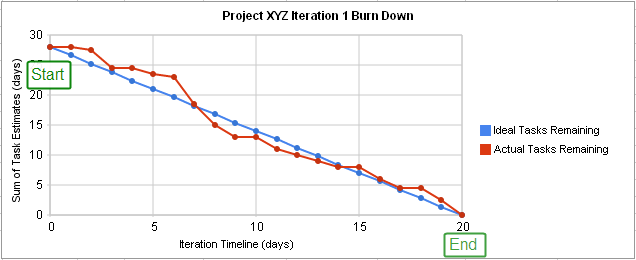
In the next Sprint, keep a note of how long you estimated each task would take, how long it actually took, and the time at which you completed the task so that you can create a burndown chart for Sprint 2.
- The Sprint Retrospective is meeting for only the Scrum Team.
- The Sprint Retrospective is held after the Sprint Review to reflect on what went well, what could be improved, and to identify actionable changes for the next Sprint.
- Actionable improvements identified in the retrospective should be documented and carried forward into the Product Backlog or future sprint planning to ensure continuous improvement.
- Burndown charts visualise progress during the Sprint by comparing estimated effort against actual effort, highlighting whether the team is ahead or behind schedule.